A Forgotten Industry That Shaped the Pine Forests
Walk through the pine forests of Taylor County today and you’ll see endless stands of second- and third-growth timber. But more than a century ago, those same woods echoed with the sound of axes, the clang of barrels, and the low hiss of turpentine stills. This was the age of the naval stores industry—an industry that once placed Florida at the top of national production and made Perry and its surrounding communities an important part of that story.
What Were “Naval Stores”?
The term naval stores goes back centuries. Originally, it described the products—pitch, tar, turpentine, and rosin—used to seal and maintain wooden ships. Long before Florida became a state, people from Macedonia to colonial Virginia were boiling pine resin for waterproofing and preservation. By the 1600s, stills in Virginia, New England, and later the Carolinas gave rise to a thriving trade. The nickname “tar heel,” given to North Carolinians, traces its origin to these early naval stores workers.
By the late 1800s, the longleaf and slash pine forests of the Deep South were the new frontier of naval stores. Florida, once a minor player, accounted for barely 1% of U.S. production in 1850. But by 1910, it supplied more than half of the nation’s output, surpassing Georgia as the industry leader. Taylor County stood right in the middle of this boom.
Taylor County’s Boom Years
From 1905 to 1923, Florida dominated the naval stores trade. During this period, Taylor County’s landscape became a patchwork of leases, stills, commissaries, and camps. Natives could point in every direction to the names of operations: the 9-Mile Still, Potts’ Still, Huxford’s Still, Aycock-Lindsey, H. J. Westberry, Blue Creek Turpentine Co. and more. Nearly all old-timers remembered mentioning, in a curious way, that “Captain Brown operated along the beach road”.
Urban Potts is said to have been among the first operators, buying land in 1900 for just $30. By the 1920s, stills numbered in the dozens. Families like the Malloys, the Potts, and later the Huxfords and Lindseys built fortunes—or lost them—on the sticky business of tapping pine trees.
In its peak year of 1928, the Aycock-Lindsey Company, based near Athena, was reportedly the largest turpentine operation in the world. That year, the company employed 1,400 men, ran 11 stills, and produced over 15,000 barrels of spirits and more than 54,000 barrels of rosin. They even owned their own rail tank cars to ship products directly to markets in Chicago.
How the Industry Worked
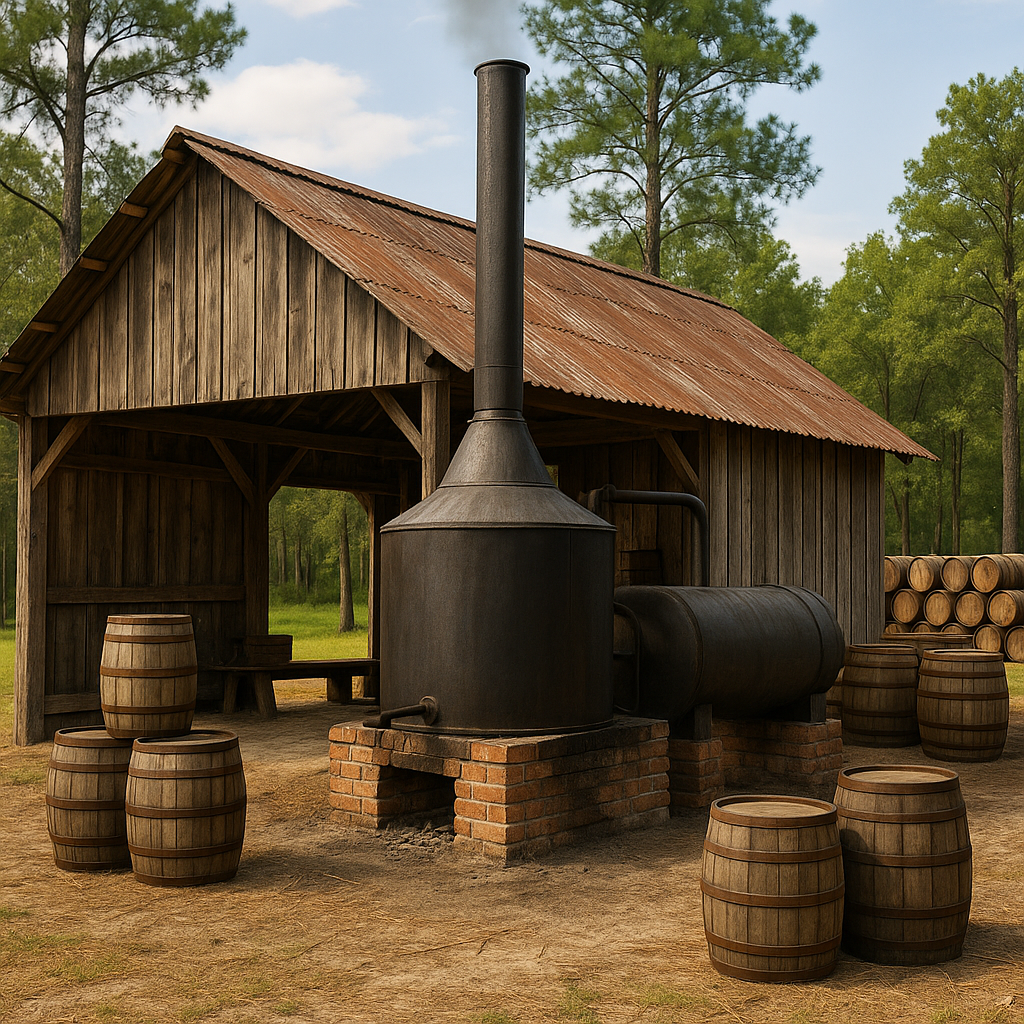
The process was grueling and labor-intensive. Workers cut a “face” into the base of a pine tree, carving V-shaped scars called catfaces. Resin oozed down into clay or tin cups fastened to the tree. Barrels of gum were hauled to stills, where they were boiled in copper kettles and distilled into three products: turpentine (a volatile liquid used in paints and solvents), rosin (used for varnishes, soaps, and even violin bows), and dross (a leftover residue used for fires).
Early methods were destructive. “Boxing” a tree—cutting deep cavities to collect resin—left trees weakened and prone to wind damage. By 1901, this method was outlawed, thanks to pressure from lumber companies that recognized the poor quality of boxed timber. Later, operators experimented with applying acid to increase resin flow, but that practice didn’t spread until the 1940s.
Camp Life and Labor
Turpentine camps were small, self-contained communities. They included rough shanties or houses for workers, larger dwellings for overseers, and always a commissary store. Workers often received pay in scrip, a company-issued credit redeemable only at the commissary. Accounts from the period show many men falling into debt, unable to escape the cycle of owing money to the company that employed them.
Families often worked together. Men chipped and dipped the trees, women and children scraped hardened gum from bark, and overseers supervised production. A “weeder,” hired to hoe brush away from the base of trees to prevent fires, might earn just 25 cents a day.
Labor was harsh, and the workforce was largely African American, including formerly enslaved families and, in earlier decades, even convicts leased from state prisons. Overseers ensured the camps ran efficiently, though the reality for most workers was grinding poverty and little chance of advancement.
The Business Side: Leases and Fortunes
Naval stores operations were built on complex financial arrangements. Landowners leased tracts of pine forest for a set fee, often calculated by the number of “boxes” or cups cut into trees. Prices fluctuated wildly—from $25 per thousand boxes in 1903 to $100 per thousand in the 1920s. Operators like the Malloys and Potts juggled multiple leases, buying and selling stills, commissaries, and equipment.
Commissary records from a sale in 1905 listed accounts owed by workers ranging from just $2 to over $300. In one operation, the company had more than $100,000 in outstanding credit on its books. The system bound workers to the camps while enriching owners and financiers.
Notable Figures of the Era
- Urban Potts – One of the earliest operators, buying land east of today’s State Road 361-A in 1900.
- Duncan and J.H. Malloy – Brothers who arrived around 1902, running stills, sawmills, and even helping to found Perry’s First Presbyterian Church in 1905.
- Captain William Alston Brown – A colorful figure involved in timber, turpentine, sawmills, and even the Gulf sponge industry. His base was in Blue Creek.
- Aycock-Lindsey Company – The largest operator, with its base at Camp Nathan near Athena. At its height in 1928, it was the biggest turpentine operation in the world.
- J.O. Huxford and H.J. Westberry – Later figures who carried the industry into the 1930s before transitioning to timber farming
Decline of the Industry
By the 1930s, the naval stores boom had faded. Several factors contributed:
- Deforestation – Virgin longleaf pine forests were depleted by overcutting and over-tapping.
- Forest Fires – Catfaced trees were especially vulnerable. A devastating 1928 fire in the San Pedro Bay area destroyed over seven million feet of timber.
- Synthetic Alternatives – The rise of chemical substitutes reduced demand for natural turpentine and rosin.
- Market Collapse – The Great Depression slashed prices and made operations unprofitable.
By 1936, most major operations in Taylor County had closed or switched to sawmilling. The Aycock-Lindsey Company, despite its scale, suspended operations that same year. Families like the Huxfords pivoted to timber farming, clearing scarred trees and planting new pine seedlings.
Legacy and Memory
The naval stores industry shaped Taylor County in profound ways:
- Economic Foundation – For decades, turpentine and rosin were the lifeblood of Perry’s economy.
- Cultural Identity – Families, churches, and even local place names trace their roots to turpentine camps.
- Environmental Impact – The scars of boxing and catfacing changed the region’s forests, but also prompted some of Florida’s earliest reforestation efforts.
- Historical Memory – Descendants of workers and owners alike recall the smell of stills, the songs of barrel-makers, and the rough life of camp communities.
Today, only remnants remain: rusted cups buried in pine duff, faint scars on old trunks, and stories passed down through families. The Taylor County Historical Society continues to preserve this heritage, reminding us that Perry’s identity as the “Pine Tree Capital” is rooted in more than lumber—it’s bound to the forgotten world of naval stores.
When the Pines Told Their Stories
The age of naval stores in Taylor County is gone, but not forgotten. It was a time when the county’s future seemed inseparable from the pine forests that covered it. Men like Urban Potts and the Aycock-Lindsey Company staked fortunes on it. Families labored in the heat of the woods for pennies and commissary credit. And the forests themselves bore the wounds of an industry that sustained ships, industries, and households far beyond Florida.
Though the stills have long since gone cold, the story of naval stores remains embedded in the culture of Perry. The pines may be second-growth now, but they stand on the same land that once fueled an industry which connected this small county to the world.



Leave a Reply